The user has provided an exhaustive, fully-specified brief with explicit content, structure, keywords, formatting rules, and the instruction "Output ONLY the article markdown." The brainstorming skill is designed for when requirements need exploration — here every requirement is already defined. Proceeding directly to the article per the user's explicit instructions, which take highest priority.
---
AI Agents in 2026: How Autonomous Workflows Are Transforming Business Operations
Forty per cent of all business workflows will be managed by agentic AI by the end of 2026 — and India's slice of that shift is already valued at USD 0.59 billion. For Indian companies still running manual approvals, WhatsApp-forwarded reports, and spreadsheet-dependent operations, the competitive clock is ticking. AI agents for business automation India is no longer a consultancy buzzword; it is the dividing line between businesses that compound their operational advantages and those that fall irreversibly behind. This guide shows exactly how AI agents work, where they deliver the clearest ROI, and how to start deploying them.
What Are AI Agents? Beyond Chatbots and Basic RPA
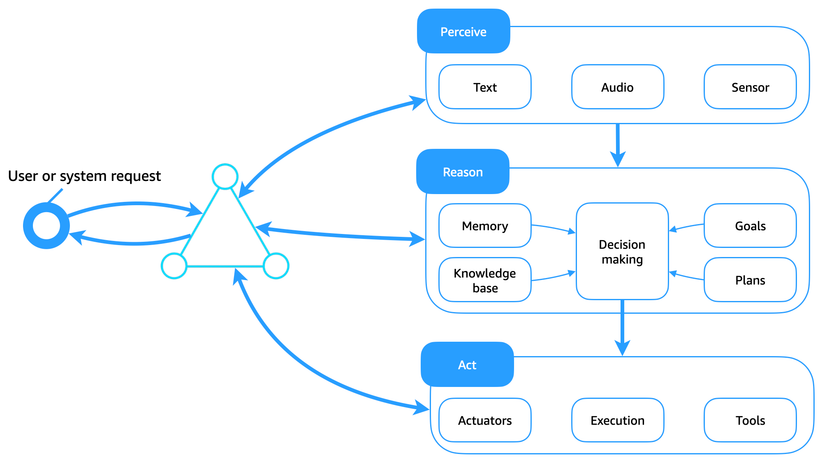
An AI agent is an autonomous software entity that perceives its environment, reasons about a goal, plans a sequence of steps, executes actions, monitors results, and self-corrects — all without a human directing each move. That definition sets it apart from anything most Indian businesses have deployed so far.
A rule-based chatbot answers predefined questions using fixed scripts. A Robotic Process Automation bot clicks through a rigid workflow sequence. Neither handles ambiguity, recovers from an unexpected outcome, or decides mid-process that an earlier assumption needs revising. An autonomous AI agent for enterprise does all three — and it does so in a continuous loop until the goal is met.
To make the contrast concrete: a chatbot handles "What is my order status?" An RPA bot extracts that status and pastes it into a spreadsheet. An AI agent receives an unstructured supplier complaint written in Gujarati, looks up the order record, checks the service-level agreement, drafts a resolution, escalates if the invoice value exceeds ₹50,000, and logs the interaction — then improves its handling of the next similar case.
The agent loop — perceive, reason, plan, act, evaluate — is what separates genuine automation from sophisticated button-clicking.
Why 2026 Is the Breakthrough Year for Indian Businesses
Three forces have converged to make agentic AI suddenly accessible to businesses of every size across India.
First, compute costs collapsed. Running a multi-step reasoning workflow on a capable large language model cost ₹50,000 per month in 2023. It now costs a fraction of that. Inference prices dropped over 90% in 36 months as hardware efficiency improved and provider competition intensified.
Second, no-code and low-code orchestration platforms removed the engineering barrier. Tools like n8n, AutoGen, and CrewAI let operations teams design multi-agent pipelines using visual builders, cutting implementation timelines from months to weeks. Hyperautomation — the combination of AI, automation, and analytics into an integrated capability — is now within reach for mid-market Indian firms, not just multinationals.
Third, and most significant for India: Meta launched its WhatsApp Business AI agent platform globally in June 2026, making WhatsApp-first agentic automation straightforward to deploy. Because WhatsApp is the primary business channel for the overwhelming majority of Indian MSMEs, this single development brought agentic automation within reach of a textile trader in Surat as readily as a logistics firm in Mumbai.
"93% of Indian business leaders plan to increase investment in AI agents over the next 12 months." — Microsoft Work Trend Index 2025
Top AI Agent Use Cases Across Indian Industries
The most mature deployments in India are in BFSI. Loan origination workflows that required 12 days of document collection, KYC verification, and credit scoring now complete in under four hours. An agent pulls Aadhaar-linked documents, cross-checks CIBIL scores via API, flags discrepancies, and drafts an approval summary — all before a human officer reviews the case. Intelligent process automation in this sector is also delivering measurable fraud detection gains, with agent-based review layers cutting false-positive rates significantly at several large private banks.
Retail and e-commerce businesses are deploying WhatsApp-native agents that handle order confirmations, returns, and multilingual support simultaneously. A single agent switches between English, Hindi, and Gujarati mid-conversation based on the customer's language, queries the ERP for stock availability, and pushes a replacement dispatch — without a human in the loop.
Manufacturing and logistics firms in Surat's textile corridor are using multi-agent orchestration for supply chain monitoring. One agent watches inbound material quality reports; another cross-references delivery timelines against production schedules; a third automatically re-routes orders when a vendor's reliability score dips below a defined threshold. Healthcare providers are deploying agents for outbound appointment reminders in the patient's preferred language, reducing no-show rates at mid-tier clinics by 30–40% in documented Indian pilots.
IT services companies — India's most comfortable terrain for AI adoption — are running CrewAI-based multi-agent pipelines across QA automation, ticket triage, and code review. Agents run regression suites overnight, file bug reports with reproduction steps, and prioritise them by severity before the engineering team logs in.
ROI and Cost Analysis: What Indian Businesses Actually Gain
The headline numbers from EY India's AI productivity research are striking: organisations deploying agentic AI report an average 171% ROI within 18 months, 40–60% reduction in operational costs, and a three-to-five times improvement in process throughput. McKinsey's operations benchmarking found a 90% reduction in resolution time for AI-augmented customer service workflows.
Those figures become vivid in rupees. A five-person operations team handling invoice processing, vendor coordination, and customer queries costs roughly ₹3.5–5 lakh per month all-in — salaries, PF, ESI, office overhead, and ongoing attrition-related hiring costs. An equivalent AI agent stack — cloud inference, orchestration platform licence, and monthly maintenance — typically runs ₹40,000–₹90,000 per month for medium-volume deployments. That is not a marginal efficiency gain; it is a structural shift in cost architecture, with the agent stack available around the clock and scaling horizontally without headcount approvals.
The compounding effect matters as much as the immediate saving. An agent that processes 500 invoices this month processes 5,000 next month with no incremental cost. A human team simply cannot scale that way.
How to Implement AI Agents: A 6-Week Roadmap for Indian Businesses
The most common mistake is starting with the most complex process. Start with the one that hurts most and is clearly defined enough to model.
A practical six-week path: in week one, map the single highest-pain manual workflow — ideally one with a clear input, a predictable set of steps, and a measurable output. In week two, select your platform. n8n suits teams wanting visual orchestration with on-premise hosting; AutoGen suits those comfortable with Python and needing flexible multi-agent reasoning; CrewAI is best for structured role-based agent pipelines. In week three, build and test a single-agent version with real sandbox data. In weeks four and five, integrate with existing tools — your CRM, your WhatsApp Business account via the official API, your ERP or accounting software. In week six, measure against your baseline and iterate.
# Example: CrewAI agent config for invoice processing
agents:
  - name: invoice_extractor
    role: "Extract invoice fields from PDF attachments"
    goal: "Return structured JSON: vendor, amount, due date, GST number"
    llm: claude-sonnet-4-6
    tools: [pdf_reader, ocr_tool]

  - name: compliance_checker
    role: "Validate against GSTIN database and DPDP data-handling rules"
    goal: "Flag non-compliant invoices before payment queue"
    llm: claude-sonnet-4-6
    tools: [gstin_api, dpdp_checker]
One step that almost no competitor guide covers: India's Digital Personal Data Protection Act 2023 applies directly to AI agent workflows that process personal data — customer names, Aadhaar numbers, mobile numbers, health records. Any agent handling such data requires a documented processing basis, defined retention limits, and a mechanism for data principals to exercise their rights. Build DPDP compliance into your architecture in week two, not as an afterthought during a regulatory audit.
No-code AI platforms India-based teams are adopting most rapidly include n8n (self-hosted), Make.com, and Zapier AI for lighter orchestration needs, with AutoGen and CrewAI for more sophisticated multi-agent architectures.
Choosing the Right AI Agent Development Partner in India
Evaluate any agency on five dimensions: domain expertise in your specific vertical; demonstrated multi-agent orchestration experience beyond single-bot deployments; WhatsApp and mobile-first integration capability given India's channel realities; robust post-deployment support with clear SLA commitments; and explicit knowledge of DPDP Act compliance — a gap most off-the-shelf resellers cannot fill.
Red flags include agencies that present a generic chatbot as an "AI agent," cannot explain their orchestration architecture in plain terms, or have no process for evaluating model performance as the underlying LLMs evolve. The right partner treats deployment as a starting point, not a handover.
Himex Infotech, based in Surat, builds custom agentic AI systems for Indian businesses across verticals — from WhatsApp automation for retail MSMEs to full enterprise-grade multi-agent orchestration for manufacturing and IT services firms. Their combination of AI development expertise, deep API integration experience, and familiarity with the Indian compliance landscape makes them a credible AI agent development company India businesses can evaluate against these criteria. For further context on agentic AI architecture patterns and research, Anthropic's published technical work remains one of the clearest references available in 2026.
Frequently Asked Questions
What are AI agents and how do they differ from chatbots? A chatbot responds to predefined inputs using fixed rules or retrieval. An AI agent perceives a goal, reasons across multiple steps, takes actions via real tools and APIs, monitors outcomes, and self-corrects when something goes wrong. An agent can complete an unsupervised multi-day workflow; a chatbot cannot complete any task that was not explicitly scripted in advance.
How much does AI agent implementation cost for a small business in India? A focused single-workflow agent deployment covering design, build, integration, and one month of post-launch support typically runs between ₹1.5 lakh and ₹5 lakh depending on complexity. Monthly operational costs — inference plus platform licence — generally fall between ₹40,000 and ₹90,000 for medium-volume deployments, compared to ₹3.5–5 lakh per month for an equivalent five-person human team.
Which industries in India see the fastest ROI from AI agent automation? BFSI leads on deployment maturity and documented ROI, particularly in loan processing, KYC, and fraud detection. Retail and e-commerce follow closely, driven by WhatsApp automation and multilingual customer support. IT services is the third fastest-moving sector, with QA automation and ticket triage delivering measurable capacity gains within the first quarter of deployment.
The Window Is Open — But Not Indefinitely
AI agents are no longer technology reserved for enterprises with seven-figure implementation budgets. The compute cost collapse, the maturation of no-code platforms, and the WhatsApp AI agent launch have made 2026 the most accessible entry point in the history of business process automation. The three core takeaways: agentic AI is now viable at every business size; the implementation barrier has never been lower; and early movers gain compounding operational advantages that become progressively harder for late entrants to close.
Ready to deploy your first AI agent workflow? Himex Infotech's team in Surat builds custom agentic AI systems tailored for Indian businesses — from WhatsApp automation to full enterprise orchestration. Get a free consultation today and see how quickly a well-scoped agent deployment can transform your operational economics.